
Key Takeaways
- Hip pain has many causes, from osteoarthritis to tendon overload, bursitis, and pain referred from the low back.
- Physical therapy treats most hip pain with targeted strengthening, mobility work, and hands-on care, often without surgery.
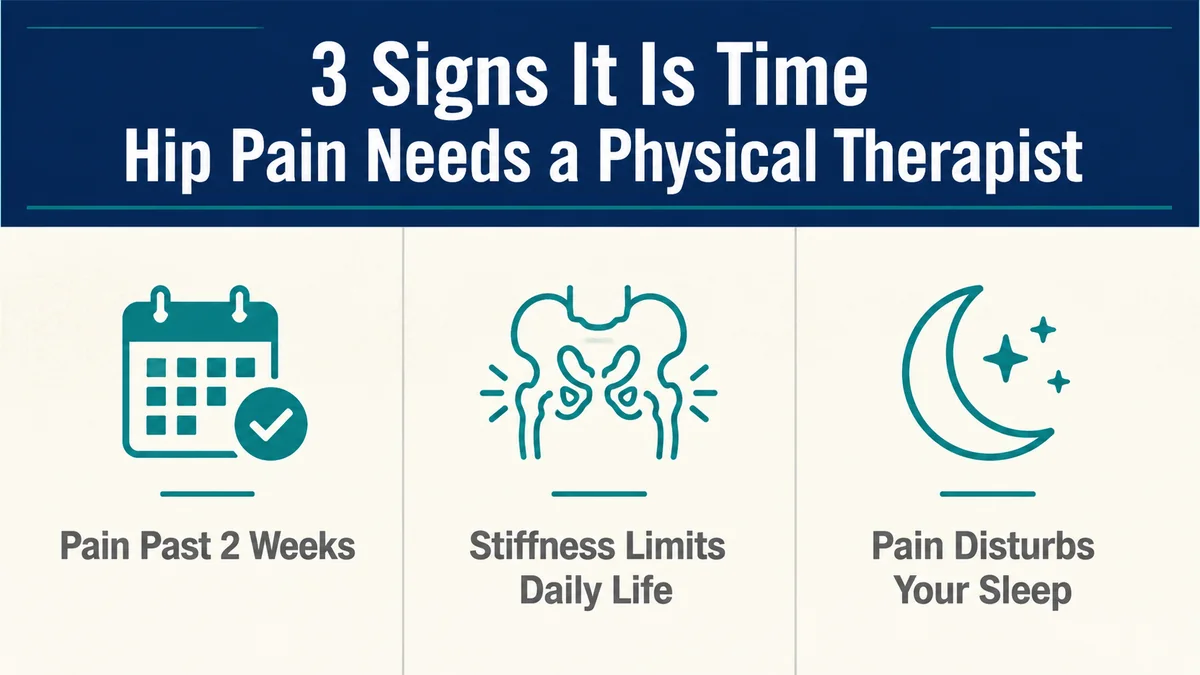
- Pain lasting past two weeks, stiffness that limits daily life, or pain that disturbs sleep are signs to get checked.
- In Mississippi, you do not need a referral to start physical therapy.

If your hip aches when you get out of a chair, stiffens on a walk, or keeps you shifting positions at night, you are not alone, and you do not have to just live with it. Hip pain is one of the most common reasons people in Houston, MS come to physical therapy, and the encouraging news is that most cases improve without injections or surgery. At Houston Physical Therapy & Performance Center, we find what is actually driving your pain and build a simple, guided plan to calm it and fix the cause. And in Mississippi, you do not need a referral to get started.
What causes hip pain?
Hip pain usually comes from the joint itself, the soft tissues around it, or from somewhere nearby that refers pain into the hip. In older adults, osteoarthritis is one of the most common drivers, as the smooth cartilage inside the joint gradually wears and the hip becomes stiff and sore. In younger and active people, the more likely culprits are tendon and muscle overload, bursitis, or a sudden jump in training.
Because the hip sits so close to the low back and pelvis, pain you feel there does not always start there. Where you feel the pain often hints at the source, and the usual sources include:
- Osteoarthritis: gradual cartilage wear that leaves the joint stiff, achy, and harder to move, especially with age.
- Tendinitis and muscle strains: overload of the glutes, hip flexors, or groin from activity, often felt on the side or front of the hip.
- Bursitis: irritation of the fluid-filled cushions on the outside of the hip that makes lying on that side uncomfortable.
- Referred pain from the low back: irritated nerves or joints in the spine that send pain and stiffness into the hip and buttock.
- Weakness and movement habits: weak hip and core muscles that let the joint take more load than it should.
Sorting out which of these applies to you is the first real step. A physical therapist looks at how your hip moves, tests the muscles around it, and checks your back and pelvis, then targets the specific driver so the pain does not simply keep coming back. You can read more about the anatomy and stages of hip arthritis from the American Academy of Orthopaedic Surgeons.
Where the pain sits gives useful clues. Pain felt deep in the groin often points to the hip joint itself, including osteoarthritis. Pain on the outer hip that is tender to the touch tends to suggest bursitis or a gluteal tendon problem, while pain in the buttock or the back of the hip is frequently referred from the low back. These patterns are not hard rules, but they help a therapist decide where to look first and which tests to run during your evaluation.
When should you see a physical therapist for hip pain?
A good rule of thumb is that hip pain lasting more than two weeks, pain that limits everyday activities, or pain that keeps you up at night is worth getting evaluated. Minor soreness after a hard day often settles on its own, but pain that lingers or changes how you move usually needs attention before it becomes a habit.
There are also a few warning signs that call for prompt medical care rather than waiting. Get seen right away if your hip pain follows a fall or injury, if you cannot bear weight on the leg, if the joint looks deformed, or if you have fever, redness, and warmth around the joint. Short of those, a physical therapy evaluation is a safe, direct place to start, and it often saves you time and cost compared with waiting to see how bad it gets.
How does physical therapy treat hip pain?
Physical therapy treats hip pain by calming the irritated tissue, restoring mobility, and rebuilding the strength that supports the joint. That usually means a mix of hands-on manual therapy, targeted stretching, progressive strengthening for the glutes and core, and coaching on how to move and load the hip through your daily activities.
The plan is not one-size-fits-all. For an arthritic hip, the goal is to keep the joint moving and the surrounding muscles strong so it can handle everyday load with less pain. For a strained tendon or bursitis, the focus shifts to settling the flare-up, then gradually rebuilding tolerance. For pain referred from the back, treating the spine and hip together is what actually works. For hip osteoarthritis specifically, the American Academy of Orthopaedic Surgeons moderately recommends physical therapy as part of first-line, non-surgical care.
This calm-it-then-build-it approach is also why physical therapy tends to give longer-lasting relief than rest or medication alone. Rest can quiet the pain for a while, but it does not fix the weakness or stiffness that let the problem start, so the pain often returns. Rebuilding the hip is what makes the relief stick.
Hands-on care and education carry a lot of the value early on. Gentle joint mobilization and soft-tissue work can loosen a stiff, guarded hip enough to let you move and exercise more comfortably. Just as important, learning what is safe to do, and telling the difference between something that is only temporarily sore and something genuinely harmful, removes a lot of the fear that keeps people stuck. That clarity often does as much for recovery as any single exercise.
What are the best exercises for hip pain?
Most hip programs are built around a few reliable moves: gentle mobility to keep the joint moving, glute strengthening to support it, and core work to steady the pelvis. Done consistently, these improve how well your hip tolerates walking, standing, stairs, and everyday tasks.
- Glute bridges: lie on your back and lift your hips, squeezing the glutes, to strengthen the muscles that stabilize the joint.
- Side-lying leg lifts and clamshells: target the outer hip muscles that keep the pelvis level when you walk.
- Hip flexor and hamstring stretches: ease the tightness that often builds up with sitting and limited movement.
- Sit-to-stand practice: rebuilds strength and confidence for one of the most common daily movements.
The details matter more than they look. The right amount, the right progression, and correct form are what turn these from generic moves into a plan that actually settles your pain. A therapist tailors the load to your hip, watches your form, and adds difficulty only when you are ready. If your hip pain has felt like it is coming from your back or radiating down the leg, our guide on back pain physical therapy is a helpful companion read, since the two areas so often overlap.
How long does it take to recover from hip pain?
Most people notice meaningful progress within a few weeks of consistent physical therapy, while more stubborn or long-standing hip pain can take a couple of months of steady work. Newer, milder problems often settle faster, and arthritic hips tend to improve in comfort and function even when the underlying wear does not disappear.
The single biggest factor is consistency, because strength and mobility rebuild gradually. That is also why starting sooner helps. Addressing hip pain early, before it changes how you walk and before the surrounding muscles weaken from disuse, usually means a faster and smoother recovery. If your pain has lingered past a couple of weeks, it is worth getting it looked at rather than waiting it out.
Everyone's path looks a little different, and a few things reliably speed it up: keeping up with your home exercises between visits, staying as active as your pain allows, and being honest about what is and is not working so the plan can adjust. Setbacks are normal too. A brief flare after a busy day does not mean you are back to square one. What matters is the overall trend, which for most people points steadily in the right direction.
Do you need a referral for hip pain therapy in Mississippi?
No. Mississippi direct access laws let you see a physical therapist without a physician referral, so you can call us and start. If your insurance requires a referral, we help you navigate it, and we verify your benefits before you begin so there are no surprises.
Not sure your hip pain has crossed the line from a nuisance to a real problem? Our guide on when to see a physical therapist can help you decide, and if your pain sits lower toward the knee, our post on knee pain physical therapy covers how the two often connect.
Frequently asked questions
What is the most common cause of hip pain?
In older adults, osteoarthritis is a leading cause, while in younger and active people, tendon and muscle overload, bursitis, and referred pain from the low back are common. A physical therapist can help sort out where your pain is actually coming from.
Can physical therapy fix hip pain without surgery?
Often, yes. Many causes of hip pain respond well to targeted strengthening, mobility work, and activity changes. The AAOS moderately recommends physical therapy for mild to moderate hip osteoarthritis, and PT is a first-line option for many other hip problems too.
How long does it take for hip pain to get better with physical therapy?
Many people notice progress within a few weeks, while more stubborn or long-standing hip pain can take a couple of months of consistent work. Starting sooner usually means a smoother recovery.
Should I rest or stay active with hip pain?
Complete rest is rarely the answer. Gentle, guided movement usually helps more than sitting still. A therapist shows you how to stay active without flaring the pain while you rebuild strength.
Do I need a referral to see a physical therapist for hip pain in Mississippi?
No. Mississippi direct access laws let you see a PT without a physician referral. If your insurance requires one, we help you navigate it and verify your benefits before you start.

Cass Tapley, PT
Cass Tapley, PT, is the owner and physical therapist at Houston Physical Therapy & Performance Center, the only locally owned, operated, and staffed physical and occupational therapy clinic in Houston, MS, serving Chickasaw County. Meet the team.
Hip pain slowing you down?
Call us today or visit any of our Chickasaw County locations. No referral is required in Mississippi.
Call (662) 456-1065Disclaimer: The content on this page is for informational purposes only and is not medical advice. Results vary by individual and are not guaranteed. Before starting any new treatment, exercise, or rehabilitation program, consult a licensed healthcare provider.