
Key Takeaways
- Recovery after ACL surgery usually takes six to nine months, and competitive athletes may need a little longer.
- Rehab starts right after surgery. The first goals are less swelling, a fully straight knee, and a working quadriceps.
- In one study, the knee reinjury rate dropped by 51% for each month return to sport was delayed, up to nine months after surgery.
- Return to sport is earned with strength and movement tests, not the calendar alone. Your surgeon gives the final clearance.
You had the surgery. Now comes the part that decides how well the new ligament works for you. Physical therapy after ACL surgery in Houston, MS starts within days of the operation and usually runs six to nine months, moving from calming a swollen knee to walking, then strength, then running and cutting, and finally a tested return to your sport.
At Houston Physical Therapy & Performance Center on the courthouse square, ACL recovery is a big part of our sports therapy work, from Chickasaw County students to weekend players and people who simply want to trust their knee on the stairs again. Here is what each stage looks like, what slows people down, and how you know you are ready to play.
How long is physical therapy after ACL surgery?
Most people need about six to nine months of rehab after ACL reconstruction before a full return to sport, and competitive athletes often need longer. You will not be in the clinic the whole time. Visits are closer together early on and spread out as you take on more of the work yourself, but the knee keeps adapting for many months.
Cleveland Clinic puts recovery from a torn ACL at six to nine months and notes that competitive athletes may need a little longer before they are cleared to play. It is a common injury, too: experts estimate that 100,000 to 200,000 people in the U.S. tear an ACL each year.
The timeline is a guide, not a promise. A meniscus repair done at the same time, how swollen the knee gets, how strong you were before the injury, and how steadily you do your home exercises can all move it. That is why good ACL rehab is built on milestones you reach, not dates on a calendar.
6 to 9 months
The usual recovery time after an ACL tear and surgery. Competitive athletes may need a little longer before they return to play.
Source: Cleveland Clinic
When does physical therapy start after ACL surgery?
Rehab starts almost right away. Many surgeons give you simple exercises on the day of surgery, and formal physical therapy usually begins within the first days to week after the operation. Early work is gentle, but it matters: the habits you build in the first two weeks shape the rest of your recovery.
The Emory Healthcare ACL program explains that rehab begins in the recovery room and that the first two weeks focus on bringing swelling down and getting the knee fully straight, with less concern about bending. By two weeks, the goal is a knee that straightens all the way, a quadriceps that is switching back on, and about 90 degrees of bend.
Why the focus on straightening? Loss of motion is the most commonly cited complication after ACL reconstruction, according to the same Emory guide, and a knee that will not fully straighten makes walking, standing, and running harder for months. Early range of motion and quadriceps work are the best prevention.
- Swelling control with elevation, ice, and gentle movement as your surgeon and therapist direct.
- Getting the knee straight through positioning and simple stretches.
- Waking up the quadriceps with quad sets and straight-leg raises.
- Walking practice with crutches, adding weight as comfort and your surgeon allow.
What happens in each phase of ACL rehab?
ACL rehab moves through phases: calming the knee, walking normally, building strength, returning to running and jumping, and finally testing for a return to sport.Each phase has goals you need to meet before the next one begins. Your surgeon's protocol sets the guardrails, and your therapist moves you forward as you meet them.
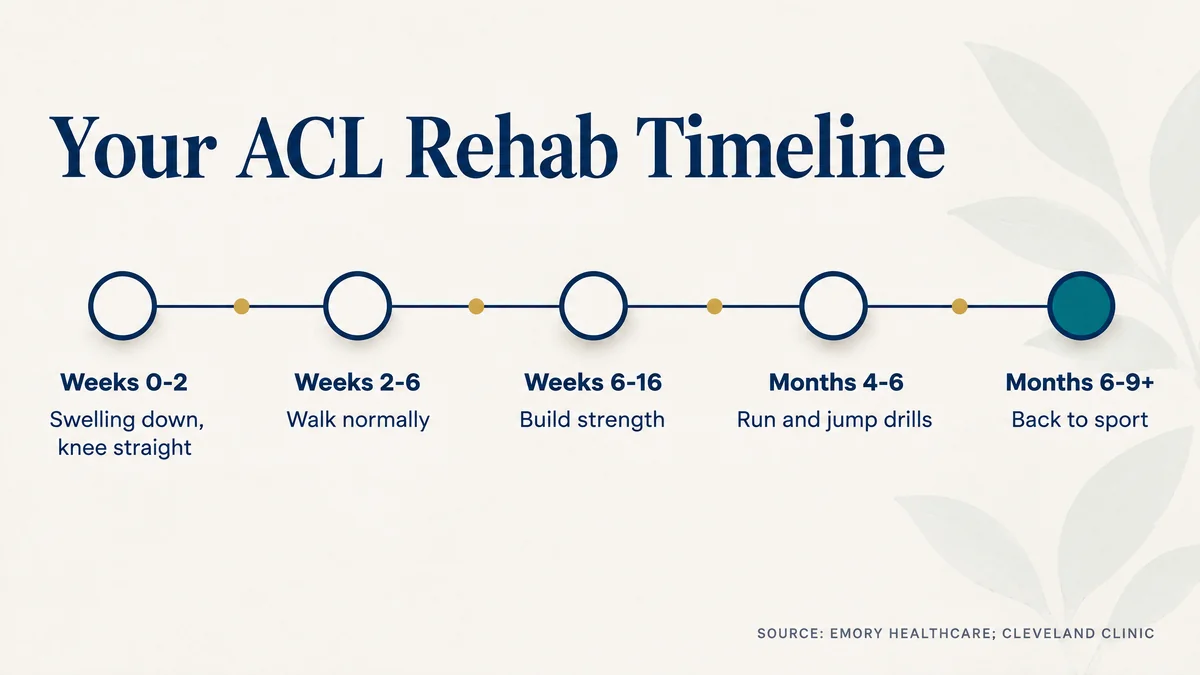
- 1Weeks 0 to 2: Calm the knee down. Bring swelling down, get the knee fully straight, wake up the quadriceps, and start walking with crutches as comfort allows.
- 2Weeks 2 to 6: Walk normally again. Keep the knee straight, work the bend toward 90 degrees and beyond, come off crutches, and build basic strength and balance.
- 3Week 6 to month 4: Build strength. Progressive strength work for the quadriceps, hamstrings, and hips, plus single-leg balance and control.
- 4Months 4 to 6: Run, jump, and cut. A gradual return to running, then jumping and landing drills, then sport-style movement, each added only when the knee is ready.
- 5Month 6 to 9 and beyond: Earn your return. Return-to-sport testing, sport-specific conditioning, and a gradual step back into practice and then games.
These windows follow the phase structure Emory Healthcare publishes for its ACL patients, and different surgeons use slightly different protocols. If you also had a meniscus repair or another ligament fixed, the early phases are usually slower, with weight on the leg limited for several weeks. Your therapist works from your surgeon's instructions, not a one-size plan.
When can I walk without crutches and drive after ACL surgery?
Many people are comfortable walking without crutches about seven to ten days after ACL reconstruction, and many are driving by around two weeks, though both depend on your surgery, which leg it was, and your surgeon's instructions. A meniscus repair or extra ligament work can mean several weeks of limited weight on the leg.
| Milestone | Typical timing | What it depends on |
|---|---|---|
| Off crutches | About 7 to 10 days | Comfort, quad control, and any meniscus repair or extra ligament work |
| Knee fully straight, about 90 degrees of bend | Around 2 weeks | Swelling and early range-of-motion work |
| Driving | Usually by about 2 weeks | Which leg, being off crutches, enough strength and control to brake safely, and your surgeon's OK |
| Return to sport | Often 6 to 9 months or more | Passing strength and movement tests, plus surgeon clearance |
Typical timings from Emory Healthcare and Cleveland Clinic. Your surgeon's instructions come first.
Back to work depends on the job. A desk job may be possible early, while work that means long hours on your feet, climbing, or lifting takes longer. If your job is physical, tell your therapist what a normal shift asks of your knee so your plan can build toward it. Our work injury physical therapy guide covers how we help people get back to demanding jobs.
When can I return to sports after ACL surgery?
You can return to sports when your knee passes return-to-sport testing and your surgeon clears you, which for most people is somewhere around nine months after surgery or later. Feeling good is not the same as being ready. The new graft and the muscles around it need time and proof.
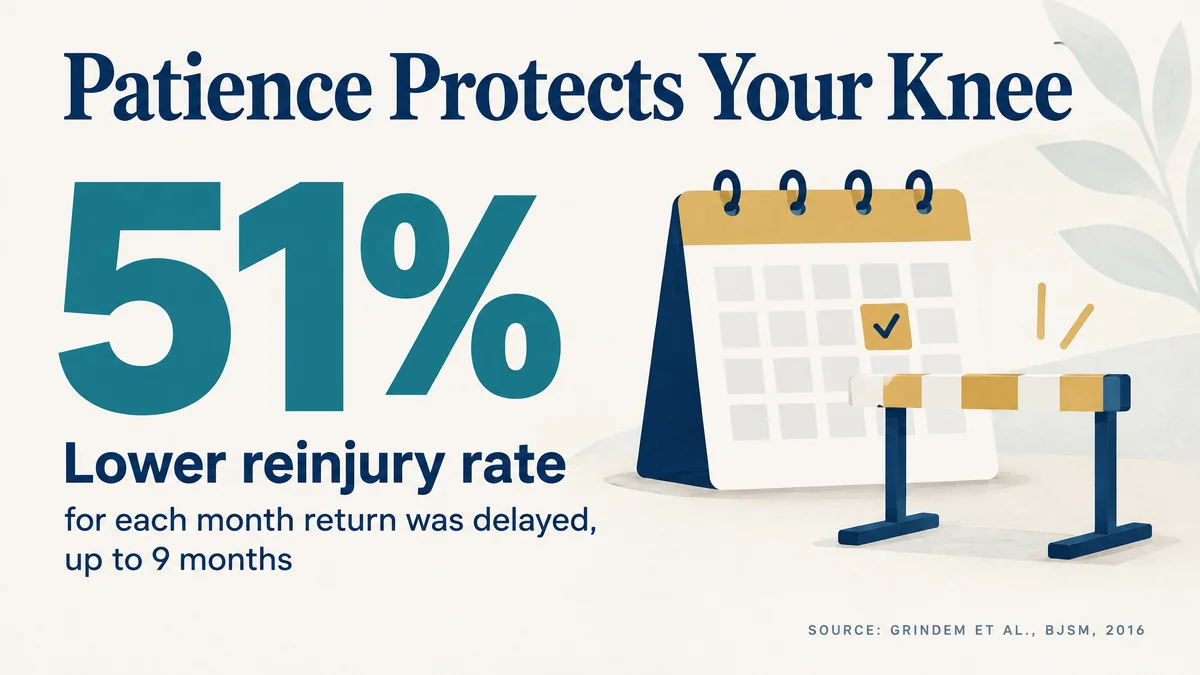
The research on this is clear. In the Delaware-Oslo ACL cohort study (Grindem and colleagues, British Journal of Sports Medicine, 2016), the knee reinjury rate dropped by 51% for each month that return to sport was delayed, up to nine months after surgery. More even quadriceps strength between the two legs before returning also lowered the reinjury rate.
A second study points the same way. Kyritsis and colleagues (British Journal of Sports Medicine, 2016) followed professional athletes after ACL reconstruction and found that those who did not meet six clinical discharge criteria before returning had a four times greater risk of rupturing the graft than those who met all six.
So we test before we clear. As our sports therapy program puts it, you return to play when you meet objective performance benchmarks, not arbitrary timelines. Testing usually looks at:
What return-to-sport testing checks
- Quadriceps and hamstring strength compared with your other leg
- Single-leg hop tests for distance and control
- How you land, jump, and change direction
- Full, pain-free motion with no lingering swelling
- Your confidence in the knee, because fear of reinjury is real
The final step back into practice and games is gradual. Our clinic is a SportsMetrics certified clinic, and that ACL injury prevention program, with its plyometrics, strength work, and movement analysis, fits naturally into the late stage of rehab. Our sports injury recovery guide explains more about how we work with local athletes.
The calendar tells you when it is safe to start testing. The tests tell you when it is safe to play. We would rather you miss a few more weeks than a whole season.
How we approach return to sport at Houston Physical Therapy & Performance Center
Do I need a brace after ACL surgery, and can the pool help?
Whether you wear a brace after ACL surgery depends on your surgeon. Many use one only early on, and research has not shown long-term benefits from bracing for knee looseness, motion, or function. Some people still like a brace for confidence when they first return to sport.
Emory Healthcare's ACL program describes bracing as a matter of surgeon and patient preference and notes that some physicians recommend a functional brace for the first one to two years after surgery for psychological confidence. Follow your own surgeon's plan here.
The pool can help, once your incisions have fully healed and your surgeon allows the knee to get wet. Our aquatic therapy program uses a HydroWorx EVO underwater treadmill, and post-surgical recovery, including ACL reconstruction, is one of the things it is used for. The water takes part of your weight, so you can practice a smooth walking pattern and build early conditioning with less load on the knee. Our aquatic therapy guide explains how it works.
What slows down ACL recovery?
The most common things that slow ACL recovery are a knee that never fully straightens, swelling that keeps coming back, a weak quadriceps, skipped home exercises, and doing too much too soon once the knee starts to feel good. Most of these can be caught early when you are seen regularly.
| Common setback | What usually helps |
|---|---|
| The knee will not fully straighten | Early, daily range-of-motion work and telling your therapist as soon as it feels stuck |
| Swelling flares after a new exercise | Easing the load back for a few days, then progressing more gradually |
| The thigh muscle stays weak | Steady, progressive quadriceps strengthening through every phase |
| Pain at the front of the knee | Restoring motion, strength, and kneecap mobility, which Emory notes are a priority early on |
| Feeling great at three months and wanting to play | Sticking with the plan until you pass testing, because the graft and muscles are still catching up |
The real work happens between visits. A few minutes of home exercise most days does more than a perfect session once a week. If knee pain lingers long after rehab, our knee pain physical therapy guide explains what else we look at.
Call your surgeon right away if you notice any of these
- Redness, warmth, drainage, or a fever around your incisions
- Calf pain, swelling, or tenderness in the lower leg
- Sudden shortness of breath or chest pain: call 911
- A new pop, giving way, or sudden heavy swelling in the knee
Frequently asked questions
Can I do my ACL rehab in Houston if my surgery was somewhere else?
Yes. Many people in Chickasaw County have surgery at a bigger hospital and then do their rehab close to home, which makes it far easier to keep up two or three visits a week. Bring your surgeon's protocol and any restrictions to your first visit. Your therapist builds your plan around them and keeps your surgeon in the loop as you progress.
How many times a week will I need physical therapy after ACL surgery?
It changes as you heal. Visits are usually more frequent in the first months, when swelling, motion, and walking need close attention, and then spread out as you take on more of the work at home and in the gym. Your therapist sets the schedule with you and adjusts it at each stage based on how your knee is responding.
Is it normal for my knee to swell during ACL rehab?
Some swelling is common, especially in the first weeks and after you add something new, like running. Your therapist watches it closely, because swelling that stays up is a sign the knee needs the load eased back for a few days. Sudden heavy swelling, redness, warmth, or a fever is different and needs a call to your surgeon right away.
Will my knee ever feel normal again after ACL surgery?
Many people return to work, daily life, and sport and feel confident in the knee again, but it takes months of steady work and results vary from person to person. Strength, balance, and trust in the knee come back gradually. Finishing the full rehab, not stopping when the pain fades, gives you the best chance of a knee that feels like yours again.
Do I need a referral for physical therapy after ACL surgery?
Mississippi allows direct access to physical therapy, so you can call us and book without a referral. After surgery, though, your surgeon usually sends orders or a protocol, and some insurance plans ask for a physician's order. Our front desk can help you sort that out when you call.

Cass Tapley, PT
Cass Tapley, PT, is the owner and physical therapist at Houston Physical Therapy & Performance Center, the only locally owned, operated, and staffed physical and occupational therapy clinic in Houston, MS, serving Chickasaw County. Reviewed by Cass Tapley, PT. Meet the team.
Do your ACL rehab close to home.
Call us or stop by the clinic on the courthouse square in Houston. Bring your surgeon's protocol, and we will build a plan that gets you from crutches back to the things you love.
Call (662) 456-1065Disclaimer: The content on this page is for informational purposes only and is not medical advice. Results vary by individual and are not guaranteed. Always follow your surgeon's instructions, and before starting any new treatment, diet, exercise, or supplement regimen, consult a licensed healthcare provider.