
Key Takeaways
- U.S. private employers reported about 2.5 million nonfatal work injuries and illnesses in 2024. Strains, sprains, and back injuries are some of the most common.
- Starting therapy early tends to go better than waiting weeks to see if the pain fades on its own.
- Good work injury rehab trains you for your real job, not just for a set of exercises on a mat.
- A fall from height, a crush injury, numbness, or weakness needs a medical look first. Therapy comes after.
It might have been one bad lift off a pallet. It might have been months of the same motion on the line until your shoulder finally said no. Either way, a work injury brings more than pain: lost shifts, paperwork, and the worry about whether you can do your job the way you did before. Work injury physical therapy in Houston, MSis about answering that last question with a plan. At Houston Physical Therapy & Performance Center we treat the injury, and we train you for the work you actually do, so going back is a step you are ready for and not a gamble.
What work injuries does physical therapy treat?
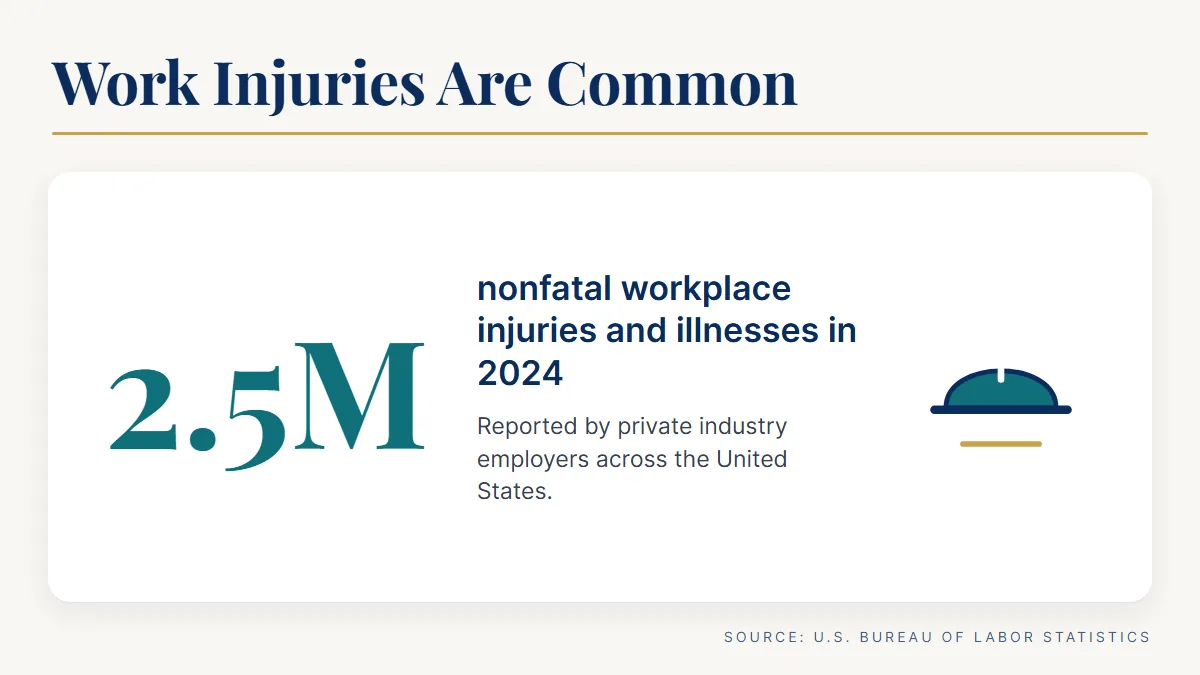
Physical therapy treats most of the muscle, joint, and tendon injuries that happen on the job, from a strained back to a sore shoulder, wrist, or knee. Work injuries are common. The U.S. Bureau of Labor Statistics reports that private industry employers recorded 2.5 million nonfatal workplace injuries and illnesses in 2024.
Work injuries we see often
- Low back strains from lifting, twisting, or long hours bent over
- Shoulder pain from overhead work or repeated reaching
- Wrist and hand problems like carpal tunnel and tendonitis
- Elbow pain from gripping tools all day
- Knee and ankle injuries from slips, falls, and ladders
- Neck pain from long shifts at a desk, a screen, or a steering wheel
Hand and wrist injuries go to our hand therapy team, which includes a Certified Hand Therapist. Back injuries are covered in more depth in our guide to back pain physical therapy, and gripping injuries in our guides to carpal tunnel and tennis elbow.
Why does starting therapy early matter?
Starting therapy soon after an injury usually beats waiting weeks to see if it fades, because the longer you guard a sore area, the stiffer and weaker it gets. Pain changes how you move. You start lifting with one side, limping a little, or holding your neck still, and those habits can create new problems on top of the first one.
There is research behind this too. A 2012 study in the journal Spine looked at more than 32,000 people with low back pain. Those who started physical therapy within 14 days of seeing their doctor had lower overall health care costs than those who waited longer. It was not a study of work injuries alone, but the lesson carries over: early, active care tends to keep a simple problem simple.
The goal is not just to stop the hurting. It is to get you strong enough for the job you go back to on Monday, whether that is a forklift, a hospital floor, or a kitchen line.
How we approach work injuries at Houston Physical Therapy & Performance Center
What happens at the first visit?
Your first visit is an evaluation of the injury and of your job, so the plan is built around the work you need to get back to. We check how you move, what hurts and what does not, your strength and range of motion, and how the injured area handles load. We also ask what your job asks of your body: how much you lift, how often, how long you stand, and whether you climb, reach overhead, or use vibrating tools.
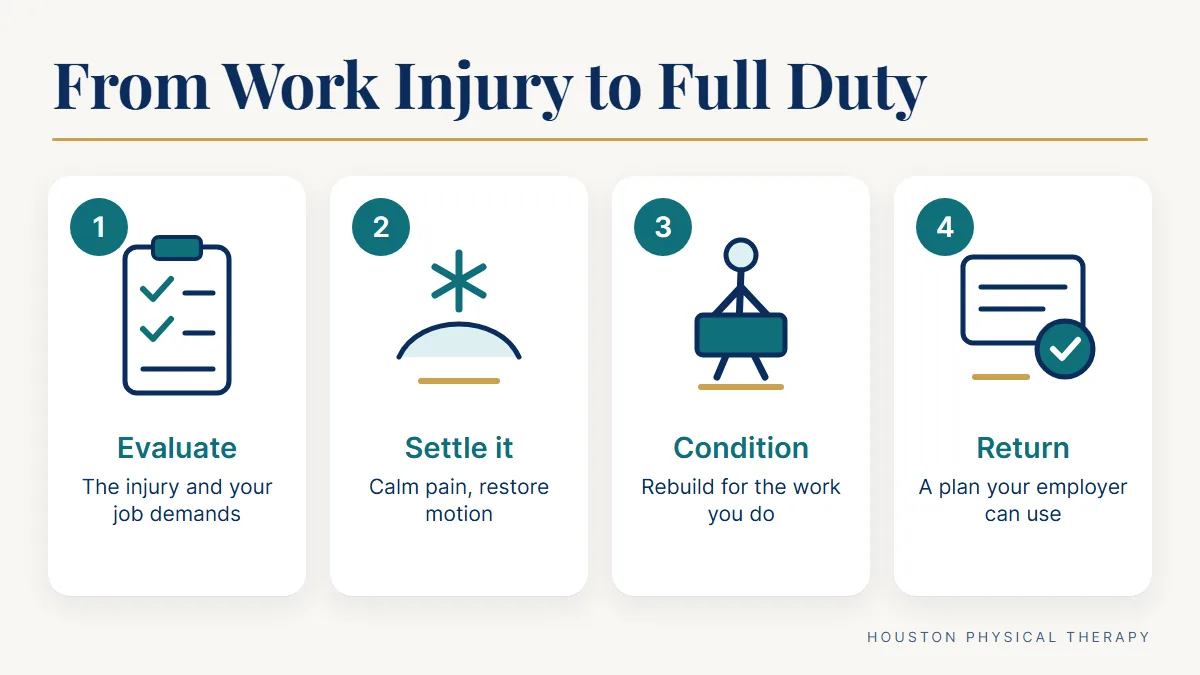
- 1Evaluate. The injury itself, plus a clear picture of your job demands. If you have work restrictions from a doctor, bring them, and we build the plan inside those limits.
- 2Settle it. Calm the pain and swelling, get motion back, and start gentle strength work. Hands-on care helps here, along with a short home program you can actually stick to.
- 3Condition. Train for the job: lifting from the floor, carrying, pushing, climbing, gripping, or standing, with the load going up as your body handles it.
- 4Return. Go back to work with a clear picture of what you can do, often starting with lighter duty and building to full duty, in step with the doctor managing your care.
What is work conditioning?
Work conditioning is the stage of rehab that trains your strength, endurance, and movement for the specific job you do, so a full shift is something your body can handle again. It comes after the injury has settled. Instead of only doing exercises on a mat, you practice the real tasks of your job, with the weight, distance, and time built up step by step.
For a warehouse worker that might mean lifting boxes from the floor to a shelf and carrying them across the room. For a nurse it might mean pushing, pulling, and standing for long stretches. For a mechanic it might mean working with arms overhead and gripping tools. Work conditioning is part of our JobMed industrial therapy program, alongside back rehab, hand rehab, and job analysis.
| Stage | Main goal | What it looks like |
|---|---|---|
| Early therapy | Calm the injury, restore motion | Hands-on care, gentle exercise, a home program |
| Strengthening | Rebuild strength and control | Progressive exercise for the injured area and the body around it |
| Work conditioning | Get ready for a full workday | Practicing real job tasks with the load built up step by step |
| Return to work | Go back safely | Often lighter duty first, building to full duty |
A general guide. Some people move through these stages quickly and some need more time.
How do we work with employers?
We keep the employer and the doctor in the loop, so everyone is working from the same picture of what you can safely do. That means clear updates on your progress and on the tasks you are ready for, which helps your employer plan lighter duty instead of guessing.
We also take therapy to the workplace. Our on-site clinic at Franklin MFG here in Houston puts care right where people work, including care aimed at catching aches and strains before they turn into injuries. Our therapists can also look at a work area and suggest changes that lower the risk of the same injury happening again. If you run a business in Chickasaw County and want to talk about on-site care, our industrial therapy page has the details.
A quick tip if you were just hurt at work
Report the injury to your supervisor the same day, even if it seems minor, and write down what happened while it is fresh. Workers' compensation claims usually go smoother when the report is made right away.
When a work injury needs a doctor first
Most strains and overuse injuries are a good fit for physical therapy, but some injuries need a medical exam or imaging before therapy starts. If there is any chance of a broken bone, a torn tendon, or nerve damage, get checked first. If you are not sure which group you are in, our guide on when to see a physical therapist can help, or just call and ask.
Get medical care first if you notice any of these
- A fall from a height, a crush injury, or a hard blow to the head
- A limb you cannot put weight on or move, or one that looks out of shape
- Numbness, tingling, or weakness that is spreading or getting worse
- Back pain with loss of bladder or bowel control: go to the ER
- A deep cut, a burn, or a chemical exposure
None of these rule out therapy later. They mean a medical check comes first, so the plan matches what is really going on.
Frequently asked questions
Can I go to physical therapy for a work injury without seeing a doctor first?
You can call us and book a physical therapy evaluation without a referral. A workers' compensation claim often has its own rules about who you see and in what order, so check with your employer or claims adjuster too. Our front desk helps you sort out what your claim needs before your first visit.
Should I keep working while I do physical therapy?
Often yes, with limits. Many people do better staying at work on lighter or modified duty than sitting at home, as long as the doctor managing the claim agrees. Your therapist can describe what you can safely do now, so your employer has something concrete to plan around.
What is the difference between work conditioning and regular physical therapy?
Regular therapy focuses on calming the injury and getting motion and strength back. Work conditioning comes after that and trains you for your actual job, like lifting, carrying, climbing, or standing for a full shift, building up until you can handle a normal workday.
What is a functional capacity evaluation?
A functional capacity evaluation, or FCE, is a longer, structured test of how much you can safely lift, carry, push, and tolerate over time. It is usually requested by a physician, an employer, or an insurer to help decide work restrictions. If you have been told you need one, call us and ask before you book.
What should I bring to my first visit after a work injury?
Bring a photo ID, your insurance card or your workers' compensation claim number and adjuster's contact, any work restrictions or notes from a doctor, and a short description of what your job involves. The more we know about the work, the more specific your plan can be.

Cass Tapley, PT
Cass Tapley, PT, is the owner and physical therapist at Houston Physical Therapy & Performance Center, the only locally owned, operated, and staffed physical and occupational therapy clinic in Houston, MS, serving Chickasaw County. Meet the team.
Hurt on the job? Let's get you back to it.
Call us or stop by the clinic on the courthouse square in Houston. We open at 7:30 on weekdays and on Saturday mornings, so therapy can fit around your shift.
Call (662) 456-1065Disclaimer: The content on this page is for informational purposes only and is not medical or legal advice. Results vary by individual and are not guaranteed. Before starting any new treatment, diet, exercise, or supplement regimen, consult a licensed healthcare provider. For questions about a workers' compensation claim, ask your employer, your claims adjuster, or an attorney.