
Key Takeaways
- Carpal tunnel syndrome is pressure on the median nerve at the wrist, which is why it shows up as numbness and tingling in the thumb, index, middle, and part of the ring finger.
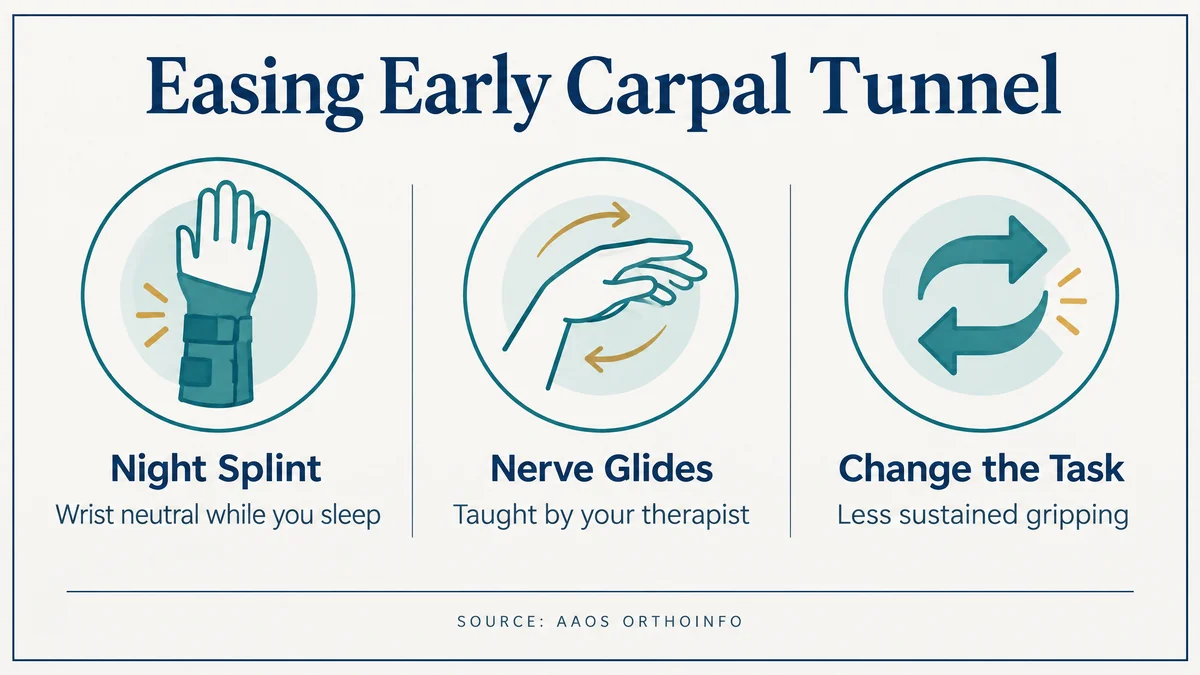
- Early symptoms often ease with a night splint, guided nerve exercises, and changing the tasks that keep squeezing the nerve.
- Exercises alone are not the answer. The research that supports therapy tested a combined program, not a single stretch from the internet.
- Constant numbness or a weakening thumb means the nerve is under real strain and you should get a surgical opinion rather than wait it out.

It usually starts at night. You wake up with your hand asleep, shake it out, and go back to bed. Then it starts happening while you drive, hold a phone, or grip a tool at work. Carpal tunnel physical therapy in Houston, MStreats the cause of that tingling, a nerve being squeezed at the wrist, and for early and moderate cases the treatment is a splint, a plan, and better habits rather than an operation. It turns up in anyone whose hands work all day, on a production line, at a keyboard, on a farm, or behind a salon chair, and at Houston Physical Therapy & Performance Center the first job is always the same: confirm it really is the wrist, then take the pressure off.
What is carpal tunnel syndrome?
Carpal tunnel syndrome is compression of the median nerve as it passes through a narrow channel in the wrist. That channel, the carpal tunnel, is about an inch wide and is shared with the nine tendons that bend your fingers and thumb. When the space gets crowded, from swollen tendons, fluid, a wrist held bent for hours, or the shape of the wrist itself, the nerve is the part that complains.
Because the median nerve supplies feeling to the thumb, index finger, middle finger, and the thumb side of the ring finger, that is where the symptoms land. Your little finger is usually spared, and that detail is one of the first things a therapist checks. The American Academy of Orthopaedic Surgeons notes that in most patients the condition gets worse over time if nothing changes, which is the best argument for dealing with it early.
It is common. According to MedlinePlus from the National Library of Medicine, carpal tunnel syndrome occurs most often in people aged 30 to 60 and is more common in women than men. Pregnancy, menopause, diabetes, rheumatoid arthritis, an old wrist fracture, and obesity all raise the odds.
What are the first signs of carpal tunnel?
The earliest sign is usually numbness or tingling in the thumb and first fingers that wakes you at night and eases when you shake your hand out. Most people sleep with their wrists curled, which narrows the tunnel for hours at a time. Daytime symptoms tend to follow with sustained gripping: steering wheels, phones, hair dryers, tools, and the computer mouse.
Signs worth paying attention to
- Tingling, burning, or numbness in the thumb, index, and middle fingers
- Waking at night with a hand that feels asleep
- Shock-like zings into the fingers when you grip or bend the wrist
- Pain or tingling that travels up the forearm
- Clumsiness with buttons, jar lids, or small screws
- Dropping things without meaning to
Dropping things is the sign people tend to dismiss, and it matters. It can come from weakness at the base of the thumb or from losing the sense of where your hand is, and either one tells us the nerve has been under pressure for a while. If you have noticed it, do not wait for the tingling to get worse before getting checked.
Does physical therapy help carpal tunnel?
Yes, for mild to moderate carpal tunnel, a therapist-led program can ease symptoms and may delay or avoid surgery, but exercises by themselves are not reliable. The honest version matters here, because a lot of advice online promises that a few wrist stretches will fix it. The Mayo Clinic is blunt that exercises alone are unlikely to relieve symptoms, and that nerve-gliding done badly can irritate a trapped nerve.
What the evidence does support is a combination. A multicentre randomized trial published in the Journal of Physiotherapy in 2020 (Lewis and colleagues) found that group education, night splinting, and a home exercise program, delivered by therapists, reduced how many people went on to surgery. That is the shape of a good plan: fewer hours of squeezing, better positions, and movement that keeps the nerve gliding instead of sticking.
We would rather spend a visit changing how you hold your tools than hand you a sheet of stretches. The nerve gets better when it stops being squeezed for eight hours a day.
How we approach hand therapy at Houston Physical Therapy & Performance Center
What does carpal tunnel therapy involve?
Carpal tunnel therapy starts with a hand and wrist evaluation, then combines splinting, nerve and tendon gliding, task changes, and gradual strengthening. Our clinic has a Certified Hand Therapist on staff, and hand therapy is one of the areas where specialised training makes a real difference.
- 1Evaluation. Grip and pinch strength, sensation in each finger, provocative tests at the wrist, and a screen of your neck and elbow. We also ask what your hands do all day, because that is usually where the fix lives.
- 2Night splinting. A splint that holds the wrist close to straight while you sleep keeps the tunnel at its widest for the hours you cannot control. For many people this alone cuts the night wake-ups.
- 3Nerve and tendon glides. Gentle, specific movements that help the nerve and tendons slide through the tunnel. Done at the right dose they help; done too hard they irritate, which is why we teach them in clinic first.
- 4Changing the task. Grip size, tool handles, keyboard and mouse height, how you hold your phone, and how long you hold any one position. Small changes, repeated every day, add up.
- 5Strength and return to work. Once symptoms settle, we rebuild grip and forearm strength so the hand handles your real work, from the production line to the garden.
For people whose symptoms started on the job, we also see patients at the Franklin MFG onsite clinic in Houston, and our industrial therapy work focuses on exactly this kind of repetitive strain.
Can carpal tunnel get better without surgery?
Often, yes, especially when it is caught early, but not always. MedlinePlus states that symptoms often improve without surgery, and also that more than half of cases eventually need it. Both are true, and the difference usually comes down to how long and how hard the nerve has been compressed before anyone dealt with it.
| Option | Best suited to | Worth knowing |
|---|---|---|
| Splint, therapy, task changes | Mild to moderate symptoms that come and go | First line for most people, no downtime |
| Steroid injection | Symptoms not settling with conservative care | Given by a physician; relief may be temporary |
| Carpal tunnel release surgery | Constant numbness, thumb weakness, or progression | Therapy afterward helps restore grip and motion |
A general guide, not a recommendation for your hand. Your therapist and physician decide this with you.
If you do end up having surgery, therapy does not stop being useful. Post-surgical hand rehabilitation is part of what we do, and getting grip and motion back after a release is a lot easier with a plan than without one.
When the problem is not the wrist at all
Not every tingling hand is carpal tunnel. A pinched nerve in the neck can send numbness down the arm into the same fingers, and a nerve squeezed at the elbow tends to hit the little finger side instead. Treating the wrist when the problem starts in the neck is a common reason people say therapy did not work. Our guide to neck pain physical therapy covers the neck side of the picture.
See a physician promptly if you notice any of these
- Numbness that is constant and no longer comes and goes
- Visible thinning of the muscle at the base of your thumb
- Weakness that is getting worse week to week
- Symptoms in both hands along with balance or walking changes
- Sudden numbness or weakness in the face, arm, or leg: call 911
None of these mean therapy is off the table. They mean the nerve needs a medical look first, and possibly a nerve conduction study, so that the plan matches what is really going on.
Frequently asked questions
Does physical therapy really help carpal tunnel?
For mild to moderate carpal tunnel syndrome, it often does, especially when it combines a night splint, education about the positions that squeeze the nerve, and a guided home program. Exercises on their own are less reliable, which is why the plan matters more than any single stretch. Severe or long-standing cases may still need a surgical opinion.
Do I need a doctor's referral for hand therapy in Mississippi?
No. Mississippi allows direct access to physical therapy, so you can schedule an evaluation without a physician referral. If your insurance requires one, we help you sort it out before your first visit.
How long does carpal tunnel take to improve with therapy?
It depends on how long the nerve has been compressed and how much of your day keeps squeezing it. Many people with early symptoms notice fewer night wake-ups within a few weeks of consistent splinting and activity changes. Your therapist rechecks your sensation, grip, and symptoms at each visit so the plan changes if progress stalls.
Should I wear a wrist brace for carpal tunnel during the day too?
Night splinting is the most common recommendation because people curl their wrists while they sleep. Daytime bracing is sometimes useful for a specific task, but wearing a stiff brace all day can weaken the hand and shift strain elsewhere. Ask your therapist which tasks, if any, justify it for you.
When is carpal tunnel serious enough for surgery?
Constant numbness that no longer comes and goes, weakness or wasting at the base of the thumb, or symptoms that keep progressing despite good conservative care are reasons to see a hand surgeon. Surgery relieves pressure on the nerve, and the earlier compression is addressed, the better the nerve tends to recover.

Cass Tapley, PT
Cass Tapley, PT, is the owner and physical therapist at Houston Physical Therapy & Performance Center, the only locally owned, operated, and staffed physical and occupational therapy clinic in Houston, MS, serving Chickasaw County. Meet the team.
Sleep through the night without shaking your hand awake.
Call us today or visit us on the courthouse square in Houston. Same-week appointments are available, and no referral is required.
Call (662) 456-1065Disclaimer: The content on this page is for informational purposes only and is not medical advice. Results vary by individual and are not guaranteed. Before starting any new treatment, diet, exercise, or supplement regimen, consult a licensed healthcare provider.