
Key Takeaways
- Arthritis means joint inflammation, and osteoarthritis, the wear-related type, is the most common form.
- Exercise is one of the most effective non-drug ways to ease arthritis pain and keep joints moving.
- Physical therapy builds strength and mobility that take pressure off painful joints and can help you stay active.
- In Mississippi, you do not need a referral to start physical therapy.
If your joints feel stiff in the morning, ache after a busy day, or complain when the weather turns, arthritis may be the reason, and there is a lot you can do about it. Arthritis is common, but it does not have to run your life. At Houston Physical Therapy & Performance Center in Houston, MS, we help you ease joint pain, keep moving, and protect the joints you rely on every day. And in Mississippi, you do not need a referral to get started.
What is arthritis?
Arthritis simply means inflammation of a joint, and it is not one single disease but a family of more than a hundred related conditions. The common thread is joint pain, stiffness, and sometimes swelling that can make everyday movement harder. It is also extremely common. According to the Centers for Disease Control and Prevention, about 53.2 million United States adults, roughly one in five, have doctor-diagnosed arthritis.
Because arthritis is a joint problem, how the joint moves and how well the muscles around it support it make a real difference in how you feel. That is the part physical therapy is built to address. It cannot reverse the underlying condition, but it can reduce pain, improve function, and help you keep doing the things that matter.
Arthritis is often thought of as strictly an older person's condition, and age is indeed a major risk factor, but it is not the whole story. Prior joint injuries, years of heavy or repetitive loading, family history, and carrying extra weight all raise the odds, and some forms affect younger adults and even children. Whatever brought it on, the day-to-day goal is the same: keep the joint moving, keep the muscles around it strong, and stay ahead of the stiffness before it limits you.
What are the most common types of arthritis?
The two types most people encounter are osteoarthritis and rheumatoid arthritis, and they work differently. Osteoarthritis is the wear-related kind and by far the most common. Rheumatoid arthritis is an autoimmune condition where the body attacks its own joints. Knowing which one you have shapes the plan.
- Osteoarthritis: gradual cartilage wear, most often in the knees, hips, hands, and spine, that leaves joints stiff and achy.
- Rheumatoid arthritis: an autoimmune condition that inflames the joint lining, often in the hands and feet, and usually on both sides of the body.
- Gout: sudden, intense flares caused by crystals in a joint, classically the big toe.
- Other forms: including psoriatic arthritis and lupus-related joint disease, each with its own pattern.
Whatever the type, the goal of physical therapy is similar: calm the symptoms, keep the joint moving, and strengthen the muscles that protect it. For inflammatory types like rheumatoid arthritis, we coordinate with the care your physician provides, working around flares and focusing on gentle, joint-friendly movement.
These types can look similar from the outside, but they are managed differently, and getting the distinction right matters. Osteoarthritis is largely a mechanical, load-related problem, so strengthening and smart activity are central to care. Inflammatory types like rheumatoid and psoriatic arthritis are driven by an overactive immune system and are managed medically by your physician, with physical therapy in a supporting role to preserve motion, strength, and function around the flares. If you are not certain which type you have, it is worth clarifying with your provider, because it shapes the whole plan.
How does physical therapy ease arthritis joint pain?
Physical therapy eases arthritis pain by strengthening the muscles around a joint, restoring lost motion, and teaching you how to move in ways that protect it. Strong muscles act like a built-in brace that shares the load, which takes pressure off the sore joint and can meaningfully reduce pain over time.
A typical plan blends gentle range-of-motion work, progressive strengthening, low-impact aerobic activity, and hands-on care to loosen stiff areas. We also coach you on the practical things: pacing your day, protecting your joints during chores, and using heat, cold, or supportive footwear when they help. The Arthritis Foundation describes exercise as one of the most effective non-drug treatments for reducing pain and improving movement in osteoarthritis, and that is exactly what a guided program delivers.
This matters because the instinct with a painful joint is often to rest it, yet too much rest tends to make things worse. Muscles weaken, joints stiffen, and the pain has an easier time taking hold. Guided, gradual movement breaks that cycle, which is why it so often outperforms rest alone.
Physical therapy also complements, rather than replaces, the rest of your care. It works alongside any medications your physician prescribes and can reduce how much you rely on them for everyday comfort. For joints that are badly worn, therapy helps you stay strong and mobile whether or not surgery is ever on the table, and it tends to improve your recovery if you do eventually have a joint replaced.
What are the best exercises for arthritis?
The best arthritis exercises are low-impact and cover three bases: gentle motion to keep joints supple, strengthening to support them, and easy aerobic activity for overall health. Done consistently, this mix reduces stiffness and helps joints tolerate daily life with less pain.
- Range-of-motion moves: gentle bends and stretches that keep joints supple and ease morning stiffness.
- Strengthening: light resistance for the muscles around affected joints, so they can share more of the load.
- Low-impact aerobic activity: walking, cycling, or water exercise that is easy on the joints.
- Balance work: steady, controlled movements that improve stability and lower fall risk.
Water-based exercise deserves a special mention, because the buoyancy takes weight off sore joints while still letting you strengthen and move. Our clinic offers joint-friendly programs for common trouble spots like the knee, and a therapist tailors the exact moves, dose, and progression to your joints so you get the benefit without the flare.
A few simple habits protect your joints while you build strength. Warming up before activity, alternating harder and easier days, and using your larger, stronger joints for heavy tasks all cut down on strain. Managing body weight helps too, because it lightens the load on the knees and hips with every step, which is one of the most effective ways to ease lower-body arthritis pain over time.
How much should you move each week with arthritis?
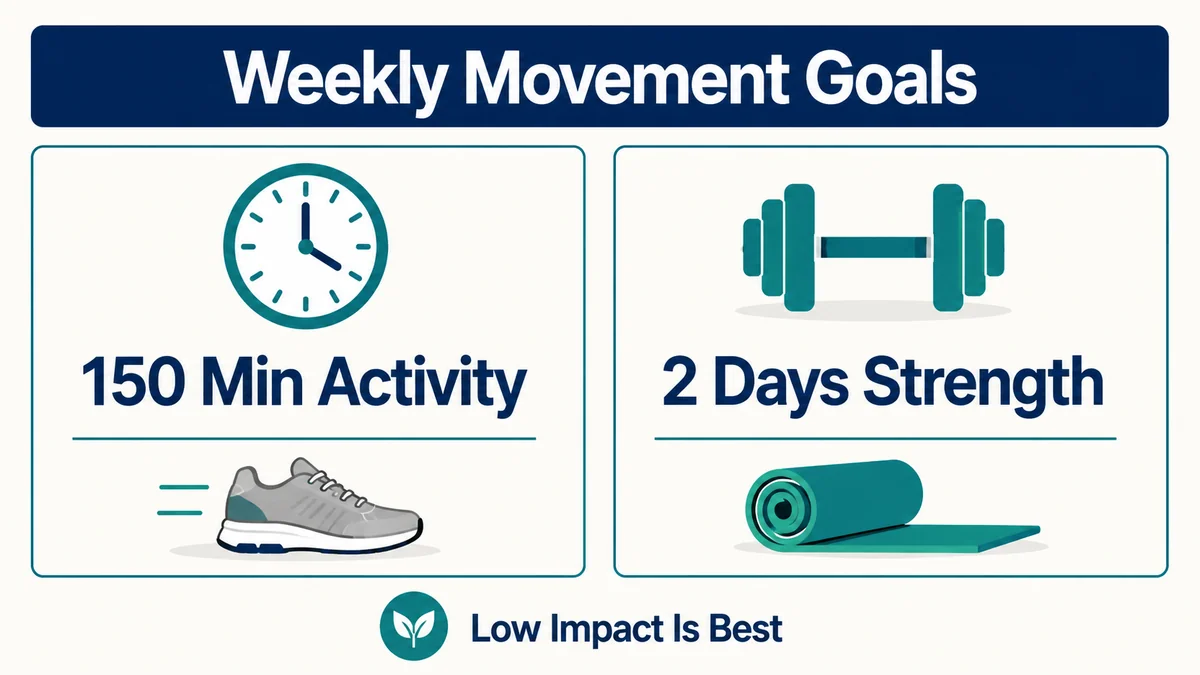
A common target is about 150 minutes of moderate activity a week plus two days of muscle strengthening, but the right starting point is wherever you can begin comfortably. Even short bouts of a few minutes count, and they add up. The goal is steady, sustainable movement, not pushing through pain.
If that number feels out of reach right now, that is completely normal, and it is exactly where physical therapy helps. We meet you where you are, start small, and build up gradually so your joints adapt instead of getting overwhelmed. A little each day, done consistently, beats an occasional hard push every time.
It also helps to spread activity through the week rather than saving it all for one day. Because movement tends to ease arthritis stiffness, many people find that gentle activity most days, even a short walk, keeps them looser and more comfortable than being sedentary and then overdoing it. Expect a little effort to feel like effort, and treat sharp or lingering pain as a cue to scale back rather than push through.
Do you need a referral for arthritis therapy in Mississippi?
No. Mississippi direct access laws let you see a physical therapist without a physician referral, so you can call us and start. If your insurance requires a referral, we help you navigate it, and we verify your benefits before you begin so there are no surprises.
Not sure whether your joint pain is worth a visit? Our guide on when to see a physical therapist can help you decide, and if your pain centers on a specific joint, our post on hip pain physical therapy walks through how we treat one of the most common arthritic joints.
Frequently asked questions
Can physical therapy really help arthritis pain?
Yes. Exercise is one of the most effective non-drug treatments for easing arthritis pain and improving movement. Physical therapy builds the strength and mobility that take pressure off sore joints, which can reduce pain and help you stay active.
Is it safe to exercise with arthritis?
For most people, yes, and it usually helps more than resting. The Arthritis Foundation notes that low-impact activity reduces pain and stiffness. A therapist tailors the intensity to your joints and progresses it safely so you do not flare up.
How much should I exercise each week with arthritis?
General guidance is about 150 minutes of moderate activity a week plus two days of strengthening, but the right starting point depends on you. A physical therapist helps you build toward that gradually without overloading painful joints.
Will exercise make my arthritis worse?
Done correctly, no. The right kind and amount of movement protects joints rather than wearing them out. Sharp or lasting pain is a signal to adjust, which is exactly what a guided program is designed to do.
Do I need a referral to see a physical therapist for arthritis in Mississippi?
No. Mississippi direct access laws let you see a PT without a physician referral. If your insurance requires one, we help you navigate it and verify your benefits before you begin.

Cass Tapley, PT
Cass Tapley, PT, is the owner and physical therapist at Houston Physical Therapy & Performance Center, the only locally owned, operated, and staffed physical and occupational therapy clinic in Houston, MS, serving Chickasaw County. Meet the team.
Ready to ease your joint pain?
Call us today or visit any of our Chickasaw County locations. No referral is required in Mississippi.
Call (662) 456-1065Disclaimer: The content on this page is for informational purposes only and is not medical advice. Results vary by individual and are not guaranteed. Before starting any new treatment, exercise, or rehabilitation program, consult a licensed healthcare provider.