Key Takeaways
- Dry needling puts a thin, solid needle into a tight, tender spot in a muscle. Nothing is injected, which is where the word "dry" comes from.
- Research suggests it can ease muscle pain in the short term, but it works best as one part of a plan that also includes exercise.
- In one large survey, about 1 in 5 treatments had a mild side effect, mostly bruising or soreness, and no serious problems were reported.
- Mississippi requires a physical therapist to finish at least 50 hours of in-person training and have it approved by the state board before using dry needling.
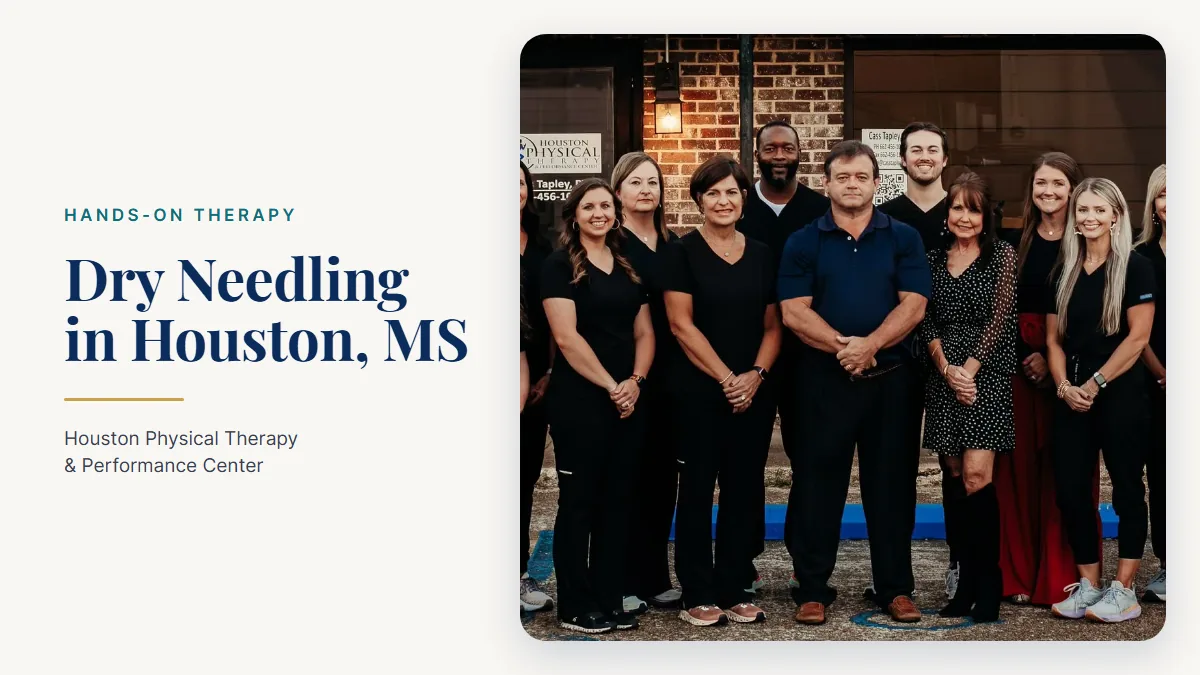
Some muscle pain does not let go. A knot under the shoulder blade that has been there since spring, a tight band in the low back that stretching never quite reaches, a calf that cramps every time you pick up the pace. Dry needling physical therapy in Houston, MS is one of the tools we use for that kind of stubborn muscle pain. It is not magic and it is not for everyone, but for the right person it can calm a sore muscle enough to let the rest of the plan work. Here is what it is, what the research honestly says, and what to expect if your therapist suggests it.
What is dry needling?
Dry needling is a hands-on treatment where a physical therapist places a very thin, solid needle into a tight, tender spot in a muscle, often called a trigger point, to help it relax and hurt less. No medicine goes in. The needle is the same thin kind used in acupuncture, far thinner than the hollow needle used for a shot or a blood draw.
A trigger point is a small, tight spot inside a band of muscle that is sore to press and can send pain somewhere else. A trigger point in the upper shoulder muscle, for example, can feel like a headache behind the eye. When the needle reaches one, the muscle often gives a quick twitch, and many people feel the area loosen afterward.
Researchers are still working out exactly why it helps. The leading ideas involve changes in the muscle itself and in how the nervous system handles pain signals from that area. What matters for you is the practical part: whether it eases your pain enough to move and exercise better.
Is dry needling the same as acupuncture?
No. The needles look alike, but the thinking behind them is different. Dry needling is based on Western anatomy and on finding the specific muscles that are part of your pain during a physical therapy exam. Acupuncture comes from traditional Chinese medicine and places needles along a system of points and pathways that has its own rules.
In practice, that means dry needling is aimed at what your therapist can feel and test: a tight band, a tender spot, a muscle that is not doing its job. It is also never the whole treatment. It sits inside a physical therapy plan, next to exercise and other hands-on care.
What can dry needling help?
Dry needling is mostly used for muscle-related pain and tightness, often as part of care for the neck, back, shoulder, hip, and knee. It is one of the techniques listed in our back and neck pain, orthopedic, and sports therapy programs.
Problems where it is often considered
- Neck and upper shoulder tightness, including tension that feeds headaches
- Low back pain with tight, guarded muscles
- Shoulder pain where the muscles around the blade stay sore
- Hip and buttock pain, including tight glute muscles
- Tight calves and hamstrings in runners and athletes
- Forearm pain from gripping, like tennis elbow
It is not the right first step for every problem. Pain from a pinched nerve, a joint that is worn or unstable, or an injury that just happened usually needs other treatment first. Our guides to neck pain physical therapy and back pain physical therapy explain how we sort out where pain is really coming from before we pick a treatment.
Does dry needling work?
For many people with muscle pain, dry needling seems to help in the short term, and the evidence is stronger for easing pain than for long-term change. A 2017 review in the Journal of Orthopaedic & Sports Physical Therapy pooled 13 studies of dry needling done by physical therapists. It found that dry needling may lower pain from right after treatment up to 12 weeks compared with sham or no treatment, but the quality of the evidence ranged from very low to moderate, and there was no clear proof of benefit at 6 to 12 months.
That is the honest picture. Dry needling is a way to turn the volume down on a sore muscle so you can move, stretch, and strengthen with less pain. The exercise is what makes the change last. That is why we do not offer it as a stand-alone fix, and why your plan will always include work you do yourself.
The needle can open a window where the muscle lets go. What you do in that window, the stretching and the strengthening, is what keeps it from tightening right back up.
How we use dry needling at Houston Physical Therapy & Performance Center
What happens during a dry needling visit?
A dry needling visit starts with an exam, then a few minutes of needling on the chosen muscles, then movement or exercise right after. You will not get needled on your first visit without understanding what it is and saying yes to it first.
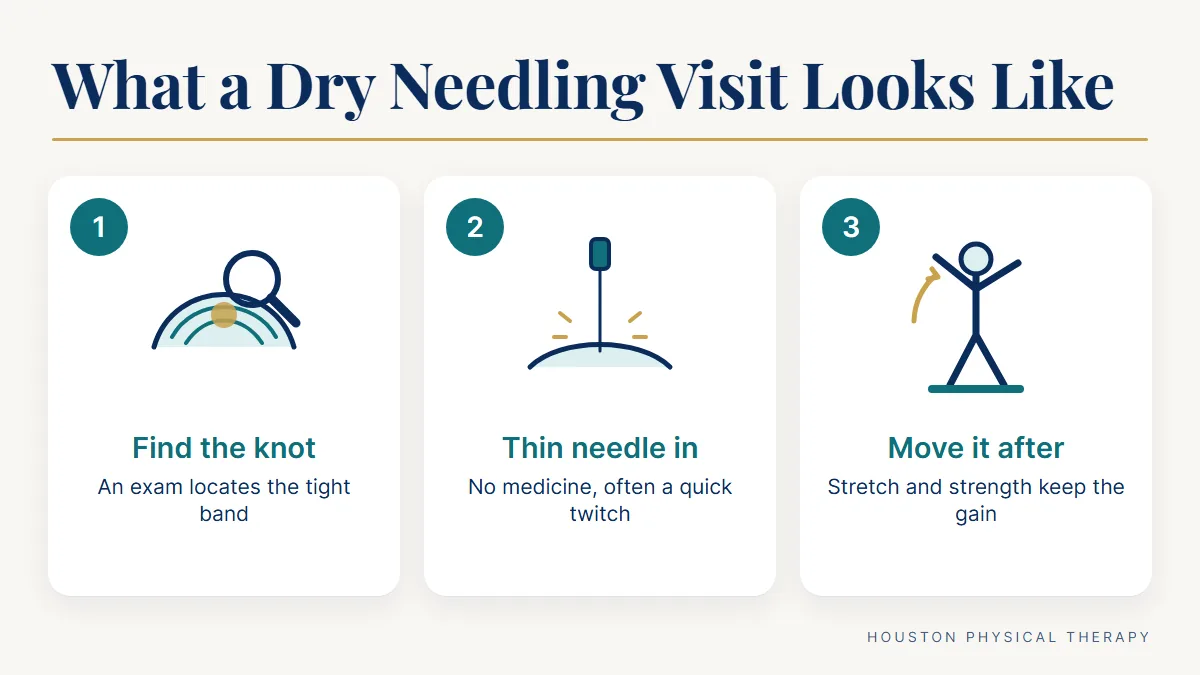
- 1Exam and consent. Your therapist checks how you move, presses on the muscles involved to find the tight, tender spots, and explains what dry needling would involve for you. You can say no and still get the rest of your treatment.
- 2Getting ready. The skin is cleaned, and the therapist wears gloves and uses a new, sterile, single-use needle for each spot. You lie or sit in a position where the muscle can relax.
- 3Needling. The needle goes in quickly. You may feel a small prick, then a deep ache or a quick twitch when it reaches the tight spot. Each needle usually stays in for a short time, from seconds to a few minutes.
- 4Movement right after. Once the needles are out, you stretch or exercise the muscle that was treated, while it is less sore. This is the part that turns short-term relief into real progress.
- 5Aftercare. Expect the area to feel like it had a hard workout for a day or so. Light movement, staying hydrated, and heat usually help. Call us if soreness is getting worse after two days instead of better.
Is dry needling safe?
When it is done by a trained therapist, dry needling has a low rate of serious problems, and mild side effects like bruising and soreness are common. In a 2014 survey published in the Journal of Manual & Manipulative Therapy, physical therapists recorded what happened across 7,629 dry needling treatments. About 19% had a mild side effect, and no significant adverse events were reported.
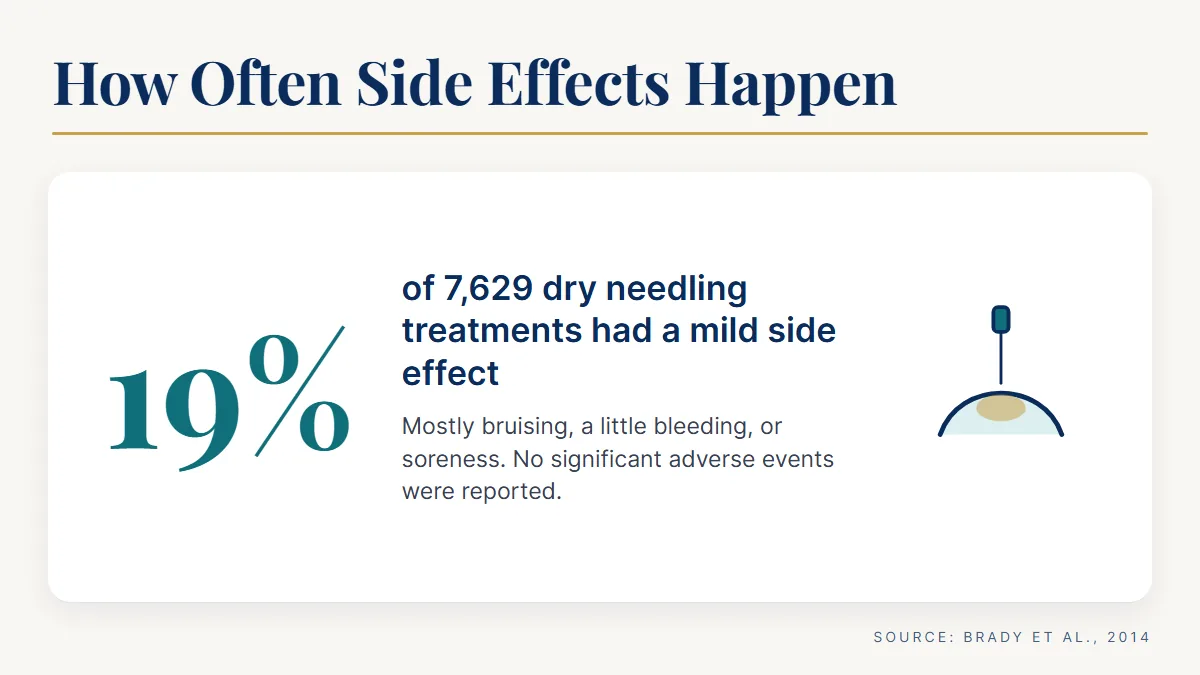
The most common mild effects were bruising, a little bleeding at the needle spot, and pain during or after treatment. Rare but serious problems are possible, such as a needle reaching the lung when muscles over the chest wall are treated, which is one reason training and careful technique matter so much.
| Tell your therapist if | Why it matters |
|---|---|
| You take a blood thinner or bruise easily | Bleeding and bruising are more likely, so the plan may change |
| You are pregnant | Some areas are avoided, and your therapist may choose other treatment |
| You have a strong fear of needles or fainting | Other hands-on options can do a similar job |
| You have an implant, a pacemaker, or swelling from lymph node removal near the area | The therapist will avoid that area or skip needling |
| You have an infection, a rash, or broken skin there | Needling waits until the skin has healed |
A general guide, not a full medical screen. Your therapist reviews your health history before any needling.
Who can do dry needling in Mississippi?
In Mississippi, a physical therapist needs extra training beyond physical therapy school before using dry needling. The Mississippi State Board of Physical Therapy rules require at least 50 hours of face-to-face dry needling coursework, completed within twelve months, with online study not counted, and the therapist's approved credentials must be on file with the board before they treat patients with it.
It is fair to ask who will be treating you and what training they have. At Houston Physical Therapy & Performance Center, dry needling sits next to the Graston Technique and other hands-on methods our therapists use, and the decision to use it is always made together with you.
A quick tip before your visit
Eat a light meal beforehand and wear clothes that let the therapist reach the sore area easily, like shorts for a leg or a loose shirt for the shoulder. People who skip a meal are more likely to feel lightheaded.
Call a doctor or 911 instead if you notice any of these
- Shortness of breath or chest pain after treatment near the chest or upper back: call 911
- Redness, warmth, or swelling at a needle spot that gets worse, or a fever
- Muscle pain with numbness, weakness, or loss of bladder or bowel control
- Pain that started with a fall or a hard hit
None of these are common. They are listed so you know what is not normal soreness and should be checked right away.
Frequently asked questions
Does dry needling hurt?
Most people feel the needle go in as a small prick, and many feel a brief cramp or twitch when it reaches a tight spot in the muscle. Soreness for a day or so afterward, a bit like after a hard workout, is common. Your therapist checks in the whole time and stops if you ask.
Is dry needling the same as acupuncture?
No. Both use the same kind of thin, solid needle, but dry needling is based on muscle anatomy and aims at tight, tender spots in a muscle that is part of your pain. Acupuncture comes from traditional Chinese medicine and uses its own system of points.
How many dry needling sessions will I need?
There is no set number. Dry needling is usually one part of a physical therapy plan, used on some visits and not others, alongside exercise and hands-on care. Your therapist decides with you whether it is helping and whether to keep using it.
Who should not have dry needling?
Tell your therapist if you take a blood thinner, have a bleeding disorder, are pregnant, have a strong fear of needles, have a pacemaker or other implant near the area, or have an infection or skin problem where they would treat. Some of these rule it out and some only change where or how it is done.
Do I need a referral for dry needling in Mississippi?
You can call us and book a physical therapy evaluation without a referral. Whether dry needling is part of your plan is decided at that evaluation. If your care or your insurance needs a physician's order, our front desk helps you get one.

Cass Tapley, PT
Cass Tapley, PT, is the owner and physical therapist at Houston Physical Therapy & Performance Center, the only locally owned, operated, and staffed physical and occupational therapy clinic in Houston, MS, serving Chickasaw County. Meet the team.
Got a knot that will not quit? Let us take a look.
Call us or stop by the clinic on the courthouse square in Houston. You can book an evaluation without a referral, and we will tell you whether dry needling makes sense for you.
Call (662) 456-1065Disclaimer: The content on this page is for informational purposes only and is not medical advice. Results vary by individual and are not guaranteed. Before starting any new treatment, diet, exercise, or supplement regimen, consult a licensed healthcare provider.